 I discharged my patient to a shelter yesterday with heparin induced thrombocytopenia recently “resolved” by argatroban (tx stopped 2 hours prior), but with no coumadin. I discharged him with a foley. I did so because I was told to do so by the doctor. I put up a totally meager fight and then sent him packing with Thursday’s copy of the New York Times that I’d brought from home, a bag with handles donated by the gift shop, a pair of flip flops and a sweat suit donated by social services, a walker donated by physical therapy and no clear idea of where he was going or how to care for himself. We just put him in a cab and sent him away.
Saturday, March 7, 2009
No Room at the Inn
I discharged my patient to a shelter yesterday with heparin induced thrombocytopenia recently “resolved” by argatroban (tx stopped 2 hours prior), but with no coumadin. I discharged him with a foley. I did so because I was told to do so by the doctor. I put up a totally meager fight and then sent him packing with Thursday’s copy of the New York Times that I’d brought from home, a bag with handles donated by the gift shop, a pair of flip flops and a sweat suit donated by social services, a walker donated by physical therapy and no clear idea of where he was going or how to care for himself. We just put him in a cab and sent him away.


Thursday, March 5, 2009
About Anonymity
 Opinions expressed on this blog are experientially based opinions. Everyday goings on from the life of one mother, student, ABD*, Oldham fan, jobless, amateur circus performer.
I just want to make that clear to anyone lurking around these parts who thinks I might actually know something about something.
For the record, I don't.
*someone actually called me this at a party over the weekend, ew!
Tuesday, March 3, 2009
He Who Would Be Prince

Bonnie's getting a lot of press lately, e.g. this boring interview. (Can I just ask, who is McLaughlin talking about when he says that "many" compare Oldham to Dylan? Jesus. Please.) Anyway, check it out simply for the ancient "Horses" video plucked from youtube.
Monday, March 2, 2009

The Attending
 Did I tell you that I inadvertently called the attending physician on Friday for blood pressure parameters for my patient's Cardizem? Learned my lesson about the hierarchy in a hurry. Yes, in fact, it was totally humiliating. And I'm not sure why, except that I didn't live it down in a hurry... And I did not get the damned parameters.
For those who don't know the system it's like this, top down: attending, resident, intern... with, at my institution of practice, multiples thereof under the attending. "Nurse" is somewhere waaayyy down at the bottom of that totem*, falling fast when one phones the attending instead of the intern.
*Oh wait, we're not a kinship group. There I go, mixing up my careers again!
Garden Poetry
 My mind is longer than any tree's branch.
My arms are like the trunk of a tree.
My hair is a bush in the garden.
My room is a treehouse swaying in the treetops.
My feet are the roots on a tree.
My fingers are like bonsai, each its own.
~The Kid, February 2009
Hello, Marmoset!

The latest greeting I receive when I see The Kid.
This nicely complements the insult he shouts when the dog is attacking:
"You little juvenile!"
Saturday, February 21, 2009
Rites of Passage

In the doorway stands the nurse's aide looking frazzled and tired, rubber gloved, holding wipes in one hand, her pager in the other, towels tucked under each arm. Her nurse is consulting with a family member and a doc about discharge of another patient. “Sarah,” says the aide, “I need your help. Please.” The nurse gives her the, “I’m-busy-with-another-patient-I’ll-be-there-soon” look that means she could be there in ten minutes or two hours. Since I am only charting at the nurse’s station I offer a hand.
I enter the room and approach the patient in her bed. “Just turn her over, please” says Therese. So, I roll the patient toward me and Therese begins to clean her. All the while I’m talking to the patient, “You’re doing a great job, Mrs. L… Here, lean toward me… Just a little longer now…” I adjust her weight, moving my right hand from her torso to her leg and realize suddenly that her extremities are really cold. I place my left hand on her back and get my face down in her face. Not breathing. My ears feel red and hot. I scan the patient from head to toe. I look at the aide. She is madly cleaning the woman, paying me no mind. Suddenly it dawns on me: the aide knows that the patient is dead. In fact, I find out later, the patient had been dead for over an hour.
Why the aide didn’t apprise me of the situation upon my entering the room is totally beyond me. Why she didn’t say anything when she heard me talking, and, more specifically, giving instruction to, a corpse, is also a mystery. My theory is that she either thinks I am deeply spiritual, or she thinks I'm crazy.
It’s a strange world, the hospital. It makes me thankful for my deep and morbid sense of humor, finally serving me well.
Return, Stroszek
 If you know Bruno S. or even know of him, this* will be of interest. Particularly poignant is his rendering of Mamatschi.
If you are not familiar with Bruno S. you can see him in Hertzog's Stroszek (1977). The saddest, despite the dancing chicken. And don't forget the Enigma of Kaspar Hauser (1974).
*It's from the NY Times, old news. I forgot to make a timely posting. Sorry
The Patient Man
 Yesterday I said goodbye to my patient of the past two weeks, a man of great heart.
He took my hand and said, "Goodbye, Dear. I'll see you in the movies."
I smiled, "I hope you fly again someday."
"I will," said he.
Yokai!
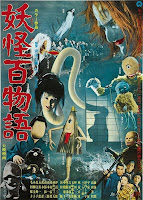 Thoroughly enjoying Yokai Monsters: 100 Monsters.
What are the Yokai? Scary Japanese monsters and spirits (Obake). Their stories come from Japanese folklore and The Captive Wildwoman has a great introduction to some of the creatures here. A reference guide of sorts, for English speakers to learn what they are all about, can be found at Yokai Attack!. I've found this to be a welcome follow-up to the now-dead Ultraman obsession that The Kid began when he was about three and which lasted for many years.
Goodbye Tiga. Hello Yokai.
Thursday, February 19, 2009
Note for Big M.

May the love see you thru,
because we need u.
Written on a plain, white, 3x5 notecard and left at bedside.
Wednesday, February 18, 2009
Sunday, February 15, 2009
The Oracle is Fulfilled
 Welcome Perseus! (BKA: Percy.) Half dachshund, half chihuahua -- that's a chiweenie to you -- and the smartest dog on the planet.
Little Something With Your Coke?
 Agranulocytosis. Dying white blood cells. Since white blood cells principally fight infection, if you develop this form of leukopenia, you're going to be at an increased risk for a whole host of contagions. What we've heard is that there is some cocaine on the market that is tainted with levamisole, an antiparasitic used in cojunction with other drugs for the treatment of cancer. It's also sold otc as a dewormer for livesock, dogs and for freshwater fishtanks. Why it's being cut into cocaine is anyone's guess, but apparently it's not the first time. However this time we have a health advisory.
Monday, February 9, 2009
To Quote, Two
 Upon seeing a fairly drunk man - looking somewhat like Charles Manson but with a more distinct nose - riding a pink and purple ten speed bike, one handed, gesticulating wildly, down Mission street at dusk, he says:
"He's a little bit Judo and a little Menudo."
Further down the road he comments to himself, "You can tell that a society is dying when camouflage is more discernable than anything else that you see."
Two fine quotes from The Partner.
If you haven't already noticed, the man is a genius.
Sunday, February 8, 2009
Wonder Where You've Been
 “Classes communicate differently and our social skills aren't the same. Working-class people aren't big on formal introductions and small talk. We use much more body language and humility. Among us, we share a lot of local history and experience, so there's much we don't have to say to each other. We tend to mumble and say 'you know' a lot. We aren't usually talking heads. Self-deprecation is often our way of exercising a work-group, working toward cooperation and trust. It's a very tribal thing. And home. Home is not a street number, not a building. Home is another word for community, for the tribe ... faces, hands, voices, mumbles and shared work.” - Carolyn Chute
Saturday, February 7, 2009
Nurses Unite!
 Talking with my clinical group this week about different kinds of hospital nursing (team and primary) I picked up from my colleagues' literature review that there seemed to be no qualitative nor quantitative difference between outcomes for the two -- neither in perceived care nor worker satisfaction. I thought the findings were interesting given the proposed phase-out of LPNs/LVNs in California. The data seemed to reflect that mortality, patient outcomes, satisfaction and nursing burnout were undifferentiated, whether four-year nurses worked on their own or whether they worked with the support of LPNs and CNAs. My clinical instructor weighed it differently, quoting one Linda Aiken who reported in a 2003 study, "hospitals with higher proportion of nurses educated at the baccalaureate level or higher, surgical patients experienced lower mortality and failure-to-rescue rates." The argument was that LPNs had unfavorable outcomes based strictly on their education.
This illustrated for me another great failure of academia. Some quantified outcomes, like this one, contain numerous confounding factors that tend to flub up reported and repeated results. The Aiken study does not illustrate better rates of care by better educated nurses; it illustrates how more resources impact outcomes. Where are the LPNs/LVNs? In poor, rural hospitals. Are there surgical centers in those hospitals? No. Are the baccalaureate educated nurses better able to care for patients? Not necessarily. Do they have more resources -- education being one of those resources? Yes. And what's the relationship of education to labor? The California labor union has systematically displaced two-year educated nurses rather than provide a means to give them the additional year they need for the BSN. So, it's not about the education but the resource -- and to whom that resource is available. It's something to mull over. Especially if you want to argue it away as being strictly about education or strictly about class, as one is wont to do. It's about access and it's about care. Look around the hospital and see who's got it and who's giving it. It's certainly not just the baccalaureate or master's educated nurses that are giving.
It occurred to me in the middle of the night that we are one year educated nurses. An interesting twist.
Subscribe to:
Posts (Atom)